In an ongoing trend seen since 2018, the number of nurses in Ontario continues to rise.
As the governing body for Registered Nurses (RNs), Registered Practical Nurses (RPNs) and Nurse Practitioners (NPs) in Ontario, CNO collects data on the nursing profession, which is used by decision-makers in the health care system.
“CNO is the authoritative source of province-wide data about nursing registration, application and employment in Ontario. This is because we are able to collect data from every nurse in the province,” said Brent Knowles, CNO’s Director, Analytics & Research. “We share our data with health system partners, to help inform health human resource planning.”
In 2026, 197,020 nurses renewed at least one certificate of registration with CNO. Most of these — 153,321 — received their nursing education in Ontario, which represents a 2.2% increase from the year before.
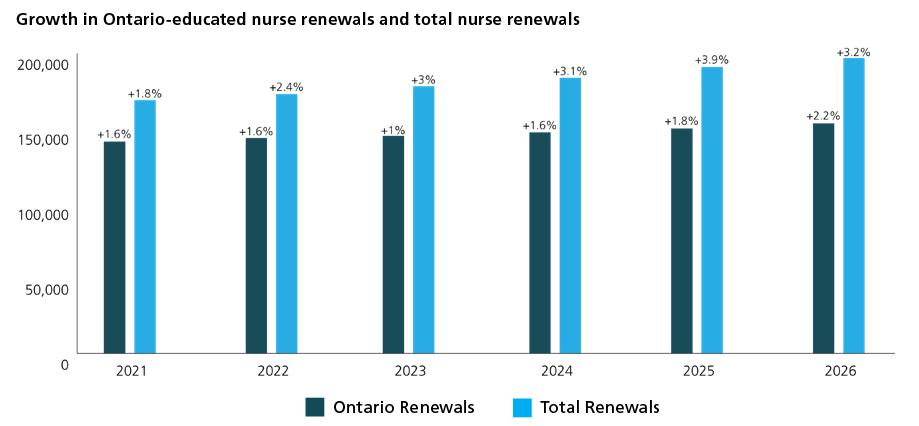
As the largest source of the province’s nursing workforce and supply, Ontario-educated nurses continue to demonstrate strong rates for renewing their nursing registrations annually with CNO. In 2026, nurses renewing their registrations for the first time had a rate of 97.8%, and since 2021, these rates have remained steady around 98%. High first-time renewal rates suggest that first-year retention is stable, and that once Ontario graduates enter the nursing profession, they are likely to register the following year.
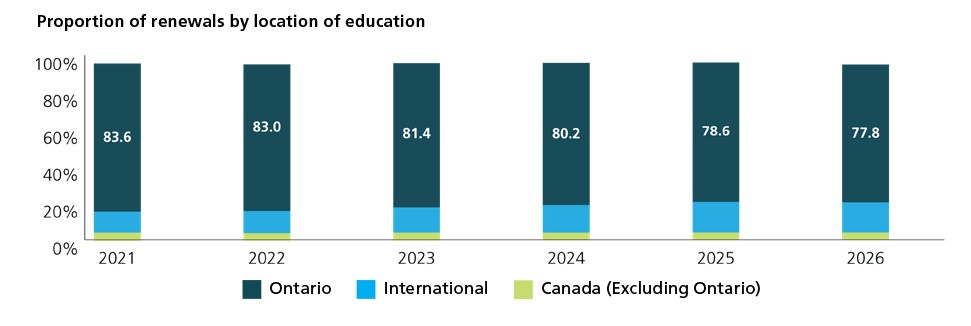
While the total number of Ontario-educated nurses continues to climb, the increase in the population of internationally educated nurses (IENs) has outpaced their growth. As a result, while Ontario-educated nurses made up 83.6% of the total nursing supply in 2021, they now make up only 77.8%.
Composition of nursing workforce evolving
CNO’s data highlights the growing importance of IENs to Ontario’s health system, as the composition of the workforce evolves. Over the last five years, growth in the nursing supply was driven in part by an increase in nurses who received their education outside of Canada. The province’s 35,635 IENs make up 18.1% of the nursing supply and nearly one-third of newly registered nurses. As well, since 2025 there has been an 8.4% increase in IENs who renewed their registration.
To support IENs, CNO has initiated strategies and made evidence-informed regulatory changes to enhance registration processes and support smooth transition to practice. CNO now accepts nursing education that is recognized or approved in any jurisdiction, if the education was designed to prepare the applicant for the category they are applying to, and it meets the credentials required. As well, a new Transition to Practice requirement helps familiarize IENs with practice in Canada. The Supervised Practice Experience Partnership (SPEP) helps applicants safely meet two critical registration requirements while integrating into the workforce.
Recognizing and including diverse educational backgrounds and qualifications reflects CNO’s adaptability. It also allows CNO to remain responsive to the needs of the health care system and the broader community, by registering nurses from around the world who have the knowledge, skill and judgment to practice safely in Ontario.
CNO releases new data resources
CNO has released three new information sheets that highlight data and information in the Nursing Statistics Report 2026. The information sheets are available on our Recent Statistical Reports page.
“The information sheets are another way of viewing the trends in the Nursing Statistics Report 2026,” said Niels Thakkar, CNO’s Manager, Analytics & Research. “They show key data points related to a specific nursing group, so you can understand trends over time at a glance. It’s an easy way to access our data, and helps readers to understand the nursing workforce narrative of 2026.”
The information sheets, which focus on Ontario-educated nurses, internationally educated nurses and members of the Non-Practising Class, each begin with a snapshot of essential statistics, followed by a focused data story, helping to make the data more digestible.
Sharing insights from the Nursing Statistics Report in this way allows CNO to share complex data in a format that a variety of system partners can reference.
Read now:
For more information, including all of CNO’s statistical reports, visit Recent Statistical Reports.